From as yet undiscovered biodiversity to resilient forests and the impact of food consumption on nature: 64 experts, including Wolfgang Wende from the Leibniz Institute of Ecological Urban and Regional Development (IOER), have now published their knowledge and recommendations in the form of “10 Must Knows from Biodiversity Science” for 2024. The Leibniz Research Network (LRN) Biodiversity's new report provides policymakers and society with concrete ways to effectively conserve and sustainably use biodiversity at the local, national, and European levels and thereby also mitigate climate change.…
With a new fellowship programme, the Leibniz Institute of Ecological Urban and Regional Development (IOER) is offering established scientists the opportunity to advance their research ideas and network during a guest stay at the IOER. The first call for applications has been launched. Applications can be submitted until 13 May 2024.
Funded by the Heisenberg Programme of the German Research Foundation (DFG), Dr Diego Rybski has been researching at the Leibniz Institute of Ecological Urban and Regional Development (IOER) since February. Over the next five years, the scientist will be investigating the question of whether cities can be understood as complex systems, similar to physics, and what conclusions can be drawn from this for sustainable urban planning. With the Heisenberg Programme, the DFG supports outstanding researchers with research projects of high quality and originality.
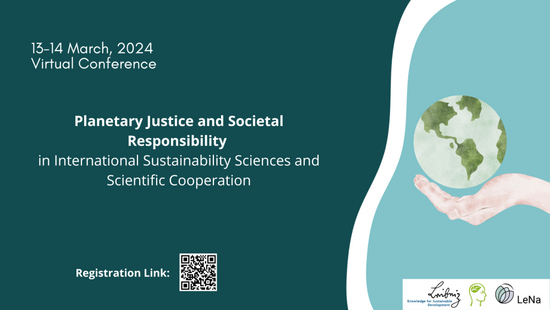
Under the heading "Planetary Justice and Societal Responsibility in International Sustainability Sciences and Scientific Cooperation", the Leibniz Research Network "Knowledge for Sustainable Development" invites interested parties to its international conference 2024. The virtual event will take place on 13 and 14 March. Conference language is English. Participation is free of charge, registration is possible until 29 February.
What needs to be achieved in spatial development, i.e. in the planning and design of landscapes, regions, cities and neighbourhoods, so that people can live quickly and permanently in harmony with nature? – The Leibniz Institute of Ecological Urban and Regional Development (IOER) will address this question at its 2024 conference under the heading "Space & Transformation: Living in Harmony with Nature". The IOER conference, including an international summer school of the Dresden Leibniz Graduate School (DLGS), will take place from 25 to 27 September at the Deutsches Hygiene-Museum Dresden.…
For the fourth time, journalists have the opportunity to apply for a research fellowship from the Leibniz Research Network "Spatial Knowledge for Society and Environment - Leibniz R". This time, the host organisation is the Leibniz Institute of Ecological Urban and Regional Development (IOER) in Dresden. Submission of applications was possible until 22 March 2024.
Which policies are suitable for tackling complex problems such as climate change adaptation? And how can we predict in advance whether a policy measure will have the intended effect? The PoliMod project at the Leibniz Institute of Ecological Urban and Regional Development (IOER) is focussing on these questions. An initial study summarises the results of comprehensive research into qualitative and quantitative modelling approaches. It has been published in the "Climate Change" series of the Umweltbundesamt.
How can actors in Saxony contribute to the fulfilment of global biodiversity goals? This question was the focus of the Interim Dresden Nexus Conference (DNCi2023) in summer 2023, a regional workshop format related to the international Dresden Nexus Conference (DNC). The summary of the results has now been published by the three organising institutions: United Nations University (UNU-FLORES), Leibniz Institute of Ecological Urban and Regional Development (IOER) and TUD Dresden University of Technology.







![[Translate to English:] Leibniz Gemeinschaft](/fileadmin/user_upload/ioer_de/img/logo-leibniz-gemeinschaft.svg)
![[Translate to English:] Dresden concept](/fileadmin/_processed_/2/1/csm_logo-dresden-concept_430c661ad7.png)