
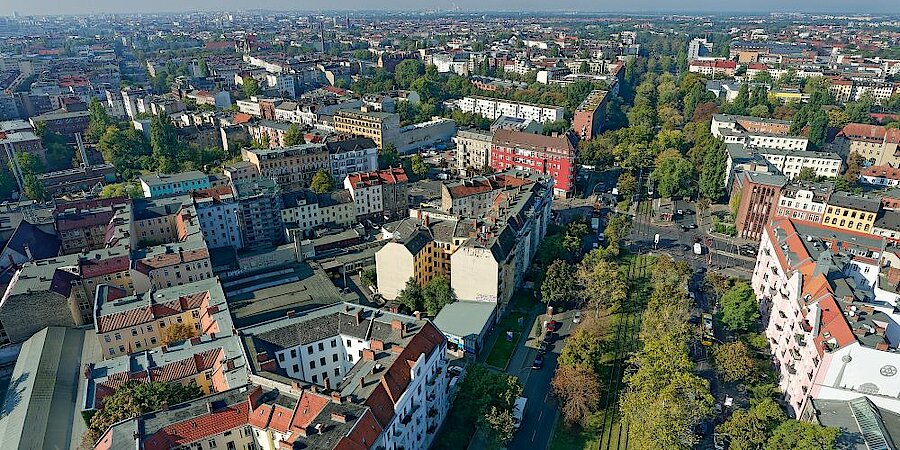
In this research area, we investigate transformative change linked to neighbourhoods, cities and regions with a view to understanding its preconditions, pathways and sustainability impacts. We build on insights regarding patterns and dynamics of socio-technical, social-ecological and socio-institutional transformations, spatial development and urban/regional economic change. On this basis our focus is on bridging disciplines and (co-)producing knowledge to conceptualise, assess and develop transformative capacities in urban and regional systems. This requires inter- and transdisciplinary research in selected geographic contexts, spatial configurations and across scales. Our overall aim is to co-design spatially informed governance approaches, instruments and methods that are able to initiate, navigate, accelerate and stabilise transformative change towards sustainability.
In the Interdisciplinary Centre for Transformative Urban Regeneration we deepen specific aspects of transformative change in small and medium-sized towns in peripheral locations as well as in regions affected by structural change. Moreover, we investigate the role of economic patterns and dynamics for the transformative capacities of cities and regions in the Research Group “Sustainable economic dynamics and innovation”.
Our guiding questions are:
- How can the transformative capacities of urban and regional systems be understood and conceptualised?
- How can the transformative capacities of specific urban and regional systems be identified, assessed and compared?
- How can governance approaches, instruments and methods be designed to increase the capacity to initiate, navigate, accelerate and stabilise transformative change in cities and regions?
![[Translate to English:] Leibniz Gemeinschaft](/fileadmin/user_upload/ioer_de/img/logo-leibniz-gemeinschaft.svg)
![[Translate to English:] Dresden concept](/fileadmin/_processed_/2/1/csm_logo-dresden-concept_430c661ad7.png)